Best Way to Move Windows Server to SSD without Reinstalling System
Why Need to Move Windows Server System to SSD?
A Solid State Drive (SSD) is a type of storage device that uses nonvolatile memory chips to store data, unlike traditional Hard Disk Drives (HDDs) with magnetic coatings. With no moving parts, SSDs offer faster read and write speeds, reduced risk of data loss due to physical shock or vibrations, lower power consumption, and quieter operation compared to HDDs.
If your Windows Server 2003/2008/2012/2016/2019 is running slower and slower over time, moving the operating system from a traditional hard disk drive (HDD) to a solid-state drive (SSD) can significantly speed up your Server computer.
How to Move Windows Server to SSD?
To move Windows Server from a traditional HDD to a new SSD without reinstalling everything, you can use the built-in Disk Management feature in Windows Server to transfer the operating system and applications to the SSD.
If the process is too complicated, you can use a third-party software called Qiling Disk Master Server, which has a "Migrate OS to SSD Wizard" feature that allows you to migrate Windows Server OS to a hard drive with simple steps. You can download its demo version for a free trial, which is compatible with both Windows Server and Windows PC.
Before you do:
▶To ensure a smooth transition, it's essential to have an unallocated space on your destination SSD or HDD that is at least as large as the used space of your current OS partition. This will provide enough room for the OS to be installed and all its associated files, ensuring a seamless migration process.
▶If there is no free space on the destination disk, you can delete an unnecessary partition or shrink a large partition to create some free space.
▶If you want to move your operating system from a disk that uses the Master Boot Record (MBR) to a disk that uses the Globally Unique Identifier Partition Table (GPT), ensure that your motherboard supports UEFI or EFI booting. If not, you can convert the target solid-state drive (SSD) to MBR, matching the source disk's configuration, before proceeding.
Step 1. Install and launch Qiling Disk Master Server. It will display your disk partition information. Click "Tools and utilities" and choose "System clone" to migrate OS to SSD.
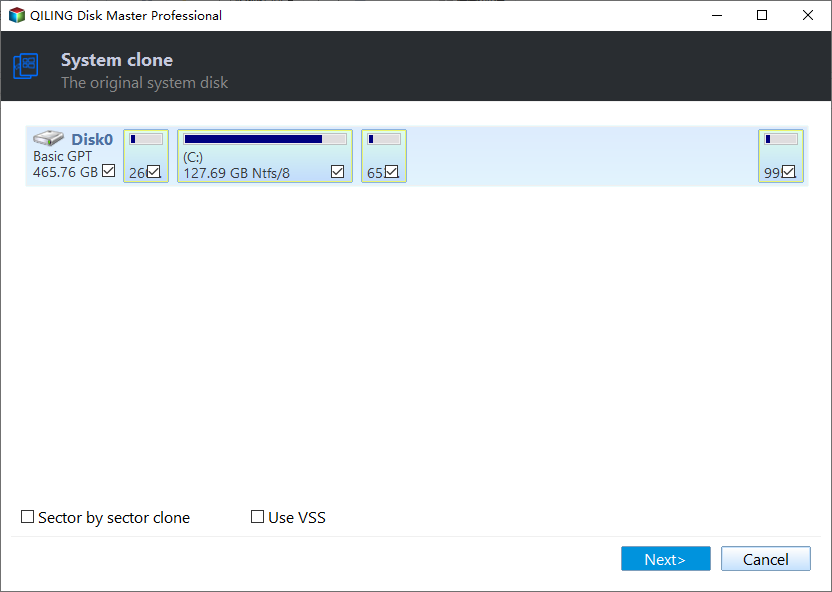
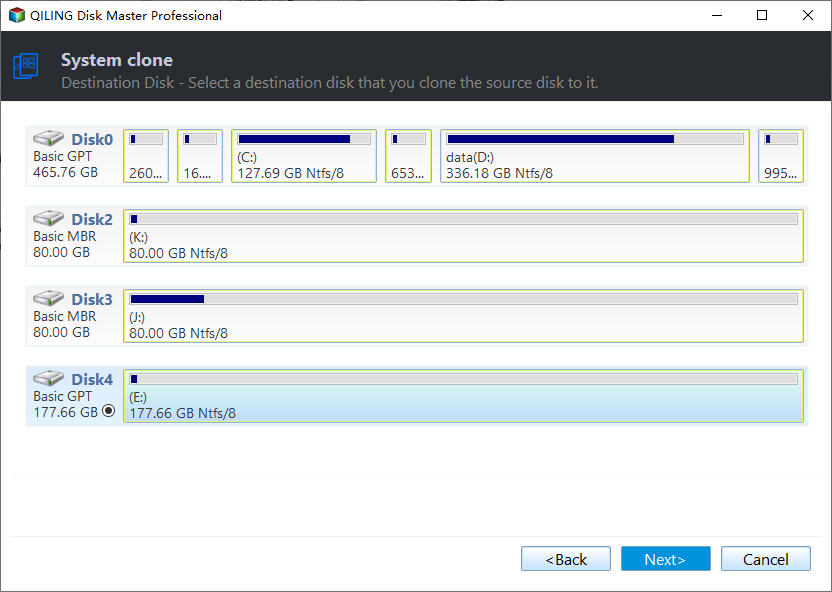
Step 2. In the next window, select an unallocated space on the SSD and then click Next.
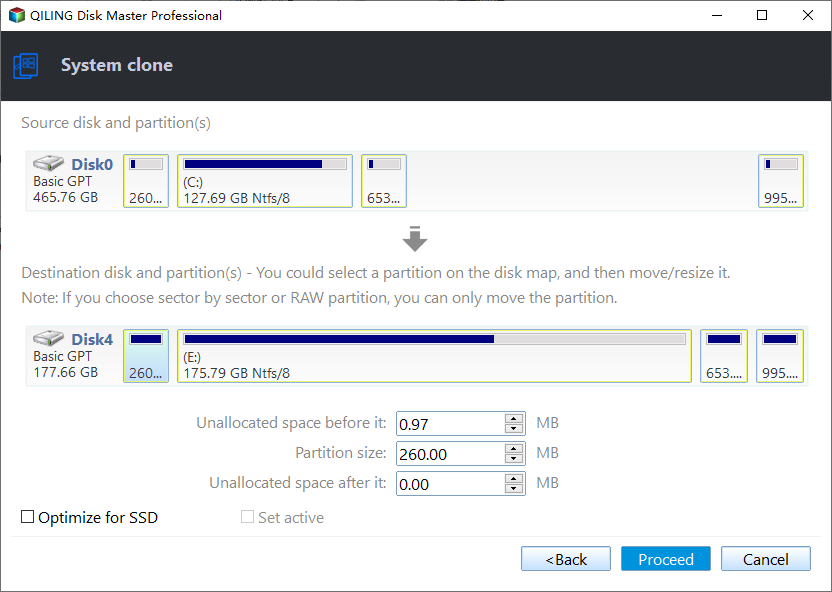
Step 3. In this window, you can modify the partition's details, including size, location, and drive letter, or keep the default settings.
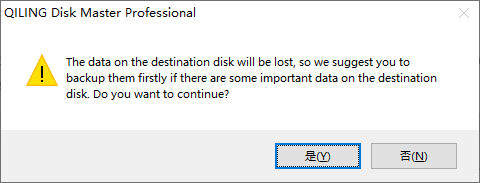
Step 4. Click Proceed button to commit the Pending Operations.
Notes:
▶This operation involves the system partition, so the operation will be completed under the PreOS Mode.
▶If you're migrating an operating system from a disk with a Master Boot Record (MBR) to a disk with a GUID Partition Table (GPT), you should enter the BIOS settings and adjust the boot configuration after the migration is finished. This step is necessary to ensure that the computer boots correctly from the new disk.
▶To boot from the SSD drive, change the boot order in BIOS to boot from the destination disk.
Summary
The Qiling Disk Master Server allows for a seamless transition of Windows Server to an SSD drive, ensuring a smooth boot process. Additionally, it offers various features such as cloning hard disks, converting MBR to GPT, converting dynamic disks to basic, and converting primary partitions to logical, among others.
Related Articles
- Freeware: Move C Drive to Larger Disk Without Reinstalling Windows
When you need to move C drive to larger disk, you can use the best software: Qiling Disk Master Professional. It is able to help you transfer operating system drive to a large hard disk and boot from it successfully without. - Move System Reserved Partition to another Drive Safely
Learn how to Move System Reserved Partition to another Drive Safely with clear steps, key checks, and practical tips. - Best Way to Upgrade MSI Gaming Laptop Hard Drive to SSD
You can easily upgrade MSI gaming laptop hard drive to SSD without reinstalling in Windows 11, 10, 8, 7 and ensure secure boot. - Best OCZ Data Migration Software for Clone & Backup
If you need to clone data from an OCZ SSD to another disk or vice versa, you'll likely require a free OCZ data migration software to facilitate this process. - Easily Migrate Windows 10 to NVMe SSD without Reinstalling
You can migrate Windows 10 to NVME SSD without Windows reinstallation. Thus, you can boot OS from the NVME SSD to experience less boot time and higher read & write speed. - Replace C Drive with SSD for Windows 11/10/8/7 [Without Data Loss]
Replace your C drive with an SSD to boost startup time, shutdown speed, and overall performance. Learn how to replace C drive with SSD on Windows 11, 10, 8, and 7 without data loss.
Products
Articles & Tutorials
- Data Recovery
- Data Backup
- File Recovery
- File Backup
- File synchronize
- System Backup and Restore
- Disk and Partition Clone
- Technical articles
- Disk Master Help
- Windows Deleted File and Disk Recovery Tutorials
- Windows File and Data Recovery Tutorials
- More Windows Tutorials for Install, Security, Files, and PC Tips
- Windows Boot, Repair, and Recovery Environment Tutorials
- Windows Backup Tutorials
- Windows Restore Tutorials
- Windows Clone and Migration Tutorials
- Windows Server Backup, Recovery, and Management Tutorials
- Windows Disk, Partition, and Storage Management Tutorials