Extend Server C Drive with DiskPart or Qiling
When C drive is full on Windows Server, services, updates, and logs may fail. DiskPart can extend C drive only in a simple layout where unallocated space is directly behind it.
Understand the problem
Server disks often contain recovery, data, or application partitions after C drive. If free space is not adjacent, deleting a partition is risky; moving or resizing partitions with a preview is safer.
- Confirm the target disk, partition, drive letter, file system, and capacity before changing anything.
- Back up or recover important files before formatting, deleting, resizing, converting, or reinstalling Windows.
- For boot-related repairs, check BIOS or UEFI mode, boot order, and disk style before editing system partitions.
Use Windows built-in tools
Use DiskPart only when unallocated space is directly after C drive.
- Back up the server or important application data.
- Open Command Prompt as administrator.
- Run diskpart, list volume, select volume C, and extend.
- If DiskPart reports no usable free extent, stop and check the disk layout.
- Do not delete a neighboring partition unless its data is already protected.
Use Qiling tools for guided steps
 Qiling Disk Master
Extend Server C drive with a disk map preview when DiskPart cannot use nonadjacent free space.
Function. Resize or move partitions with preview
Step 1. Open Qiling Disk Master and check the disk map. Identify Server C drive by drive letter, capacity, and position before changing anything.
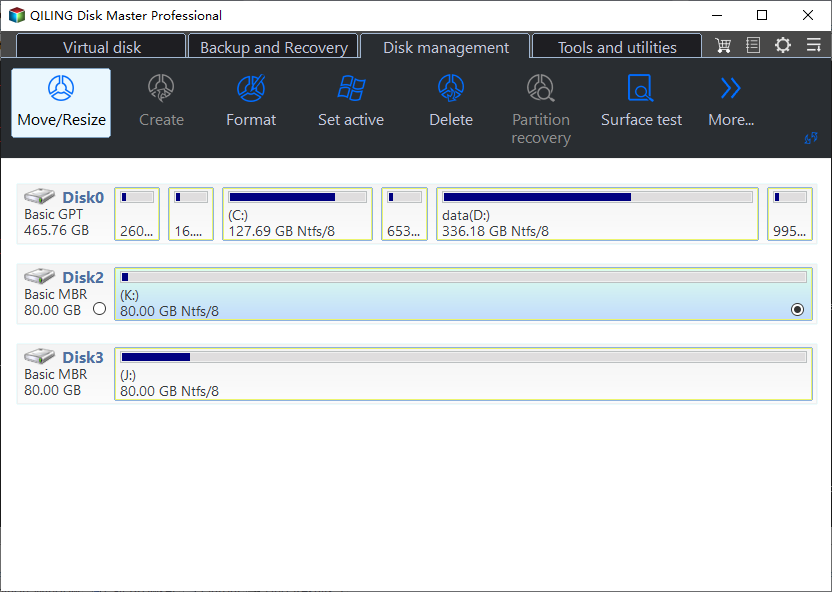
Step 2. Select the partition that needs adjustment and click Resize/Move. If unallocated space is separated by another partition, move that partition first.
Step 3. Drag the border or enter the new size to extend C drive into available or moved space. Keep enough free space for Windows, temporary files, and future updates.
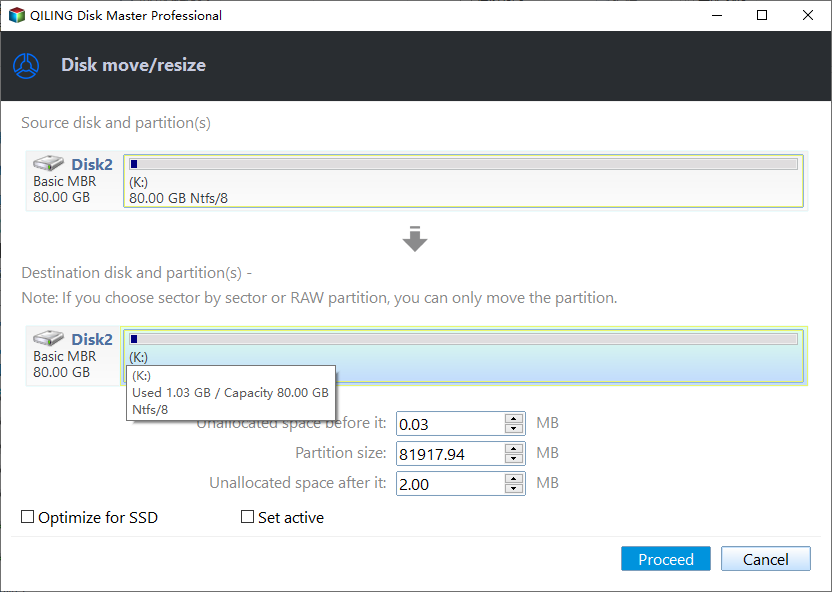
Step 4. Review the pending operations. Confirm that only the intended partition will be moved or resized.
Step 5. Click Proceed to apply the operation. Keep the computer powered on until the task completes.
Check the result
After resizing, confirm C drive capacity in File Explorer and Disk Management. Check Windows Update, event logs, and key server services.
Related Articles
-
Extend C Drive Server 2012
Increase Server C drive space when updates and services need more room. -
Add Unallocated Space Server 2016
Add unallocated space to a Windows Server partition safely.
Products
Articles & Tutorials
- Data Recovery
- Data Backup
- File Recovery
- File Backup
- File synchronize
- System Backup and Restore
- Disk and Partition Clone
- Technical articles
- Disk Master Help
- Windows Deleted File and Disk Recovery Tutorials
- Windows File and Data Recovery Tutorials
- More Windows Tutorials for Install, Security, Files, and PC Tips
- Windows Boot, Repair, and Recovery Environment Tutorials
- Windows Backup Tutorials
- Windows Restore Tutorials
- Windows Clone and Migration Tutorials
- Windows Server Backup, Recovery, and Management Tutorials
- Windows Disk, Partition, and Storage Management Tutorials