How to Create Disk Backup in Windows 11/10/8/7 Efficiently
What is Disk Backup
When carrying out the operations of hard disk backup, all the data, operating system, and programs are backed up to an image file, which can be used for disk restoration when needed. Disk backup types include full backup, incremental backup, and differential backup. Full backup saves all data, operating system, and programs, while incremental and differential backups save changes made since the last backup.
-
MBR/GPT disk backup: The MBR and GPT disk classification rule allows for disks to be categorized based on their size, with MBR supporting disks less than 2TB and GPT supporting larger disks.
-
External disk backup: An external hard drive is a separate device that stores data independently of the operating system, making it unaffected by system errors and not occupying local drive space. It's also recommended to regularly back up the external hard drive.
-
Backup of hardware RAID: RAID, or "redundant array of independent disks", is a storage technology that combines multiple hard disk drives into a single logical unit. Due to the large amount of data stored in each logical drive, it's essential to back up each one to prevent data loss.

Why do you need to create a disk backup
The main advantage of hard drive backup is data protection, allowing for easy and safe recovery of lost data from backed-up image files. Additionally, hard drive backup has other uses, including.
💻Restore computer to previous good state.
After purchasing a new computer and installing the operating system and applications, it's essential to create a disk backup. This allows you to quickly restore the operating system or data partitions if any issues arise, effectively safeguarding your data and system.
💾Upgrade hard disk excellently.
Upgrading a hard disk can breathe new life into an old one, increasing its storage capacity and performance. This process can transform a small or damaged hard disk into a good one, effectively resolving issues related to low disk space that cause slow running speeds.
📂Assist in files restoration.
Many Windows users face system crashes due to various reasons like virus attacks, hardware failures, incorrect operations, software malfunctions, or natural disasters. In such cases, if files are lost, they can be recovered from backup files.
Disk Backup vs. System Backup
Disk backup and system backup are two related but distinct concepts. A disk backup refers to the process of creating a copy of an entire hard drive or disk, including all files, folders, and operating system files, to a separate storage device. On the other hand, a system backup typically focuses on backing up the operating system, installed applications, and settings, but may not include all the data on the disk.
Disk Backup Creating a disk backup involves copying the entire disk, including system and data partitions, to capture all data, files, folders, operating system files, settings, applications, and file system structure. This type of backup is useful for disaster recovery scenarios where you need to restore the entire computer to a previous state, preserving its exact state at the time of the backup.
System Backup System backup focuses on creating backups of critical system files, settings, and configurations necessary for the operating system to function properly, ensuring the core components required for system functionality are backed up. This is more space-efficient than disk backups, which include all data and applications.
The choice between disk backup and system backup depends on your specific needs, such as the type of data being backed up, the frequency of backups, and the level of data redundancy required. Disk backup is suitable for backing up large amounts of data, such as files and documents, and is often used in conjunction with system backup to ensure complete data protection.
- Use disk backup If you're looking for a comprehensive backup solution, consider one that captures everything on your disks, providing a complete computer recovery in case of catastrophic failures.
- Use system backup If you're mainly focused on the operating system and application configurations, and you're okay with backing up user data separately, you can take a more streamlined approach to your backups. This might involve focusing on capturing the configurations and settings of your operating system and applications, rather than also backing up user data like documents, photos, and videos.
If you're using Windows 11/10/8.1/8/7/Vista/XP and want to create a disk backup, follow these steps. To do this, you'll need to refer to the guide provided.
How to Create A Disk Backup Step by Step
To create a disk backup, you can use a backup software like Qiling Disk Master Standard, which is a free option that can help protect your computer.
It allows you to backup everything on the hard disk, including the operating system, system settings, system reserved partition or EFI partition, installed programs, personal data, etc. and customize the backup task by giving backup options.
✔ Backup FeaturesThe software offers various backup options, including Disk Backup, System Backup, Partition Backup, and File Backup, catering to different user needs. The Disk Backup feature is particularly useful for capturing the image of the entire hard drive.
✔ Backup Options: You can select a higher compression To save backup space, you can use a lower level of backup, or use Intelligent Sector Backup to copy only used sectors. This way, your work will not be interrupted, thanks to Microsoft VSS or Qiling Backup Service.
✔ Schedule BackupYou can set up automatic backups to run daily, weekly, or monthly, ensuring you always have the most recent backup version.
✔ Backup SchemeYou can choose to backup only changes on the hard disk with a feature called incremental backup. This allows you to save space and only store the changes that have been made since the last backup, rather than the entire dataset. Incremental backup saves only the changed data, which saves you time and storage space while ensuring that your data is safe and secure.
The software's clear and detailed prompts guide you through the disk backup process with ease, eliminating the need for any technical expertise. Just download the free hard drive backup software and follow the prompts to perform a successful disk backup operation.
Step 1. Launch the software and go to the "Backup" tab, then select the "Disk Backup" option.
✎Tips: You can also use "System Backup" to back up system partitions required by Windows to run, except for Disk Backup.

Step 2. The "Task Name" field allows you to give a unique name to each backup task, helping you differentiate them. To select the disk for the backup, click on "Add Disk".
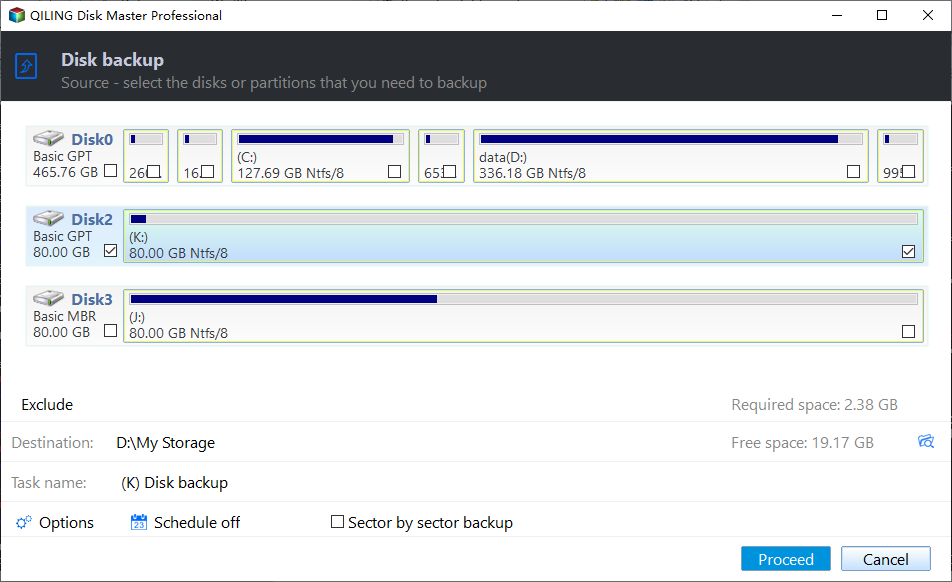
✎Note: To add multiple disks, click Add Disk and select the disk you want to back up, then restore each disk individually.
Step 3. Select a destination to store the disk image, such as a local drive, USB flash drive, CD/DVD, NAS device, or network drive, for a disk to disk backup or backup to external storage.
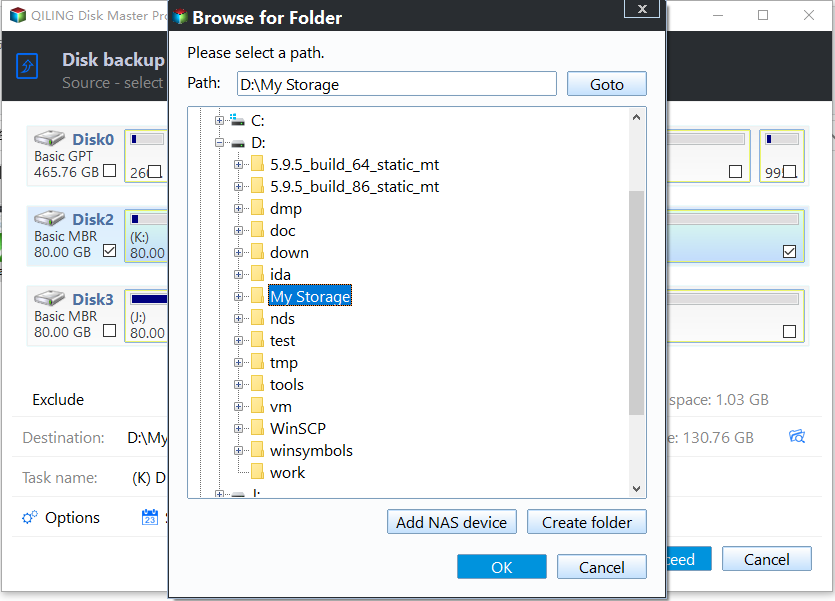
Step 4. Click "Proceed" to start the disk backup process, and wait for it to complete. Once done, click "Finish" to exit the interface.
You can upgrade to Professional edition to enjoy advanced features:
- Backup encryption: You can set a password for the backup task to prevent unauthorized access.
- Event triggers backup: The backup disk is set to run at specific events, including System Shutdown, System Startup, User Logon or User Logoff. This ensures that data is consistently backed up at key moments.
- USB plug-in backup: Once the USB is recognized, the software will automatically back up your disk.
- Differential backup: Backup only saves the changed data on the disk, and is based on the last full backup, allowing you to restore the entire disk image even if any intermediate backups are corrupted.
- Automatic cleanup: To create a retention policy, you can set a specific quantity of backups to retain, a time period after which backups are deleted, or a frequency of backups to keep. For example, you can set a policy to retain a maximum of 3 backups, delete backups older than 30 days, or keep backups taken every 7 days.
- Recovery environment: Create a boot option that allows you to one-key enter WinPE and perform backup/restore even when the system goes wrong.
- Dissimilar hardware restore: Restore Windows operating system to different hardware without boot errors.
Summary
Disk backup is crucial for all users, as inevitable disk problems or data loss can occur at any time. To avoid regret, it's essential to back up your disk beforehand. Qiling Disk Master, a powerful and free backup software, can help you resolve these issues efficiently, providing a reliable solution for safeguarding your data.
Qiling Disk Master allows you to create a disk backup simply while providing useful options to customize the backup task. You can even add comments to the backup task, which may seem simple but can help you find the backup you want quickly. For a more powerful feature, you can enable encryption for backup, differential backup, backup scheme, and more.
Related Articles
- Perform Disk Backup for Windows 10 FREE (Two Ways)
- Disk Backup vs Clone: Which One to Choose and How to Do it
- How to Create Disk Image in Windows 10/11 [2 Ways]
- How to Create ISO Image from Windows 10/11 OS (2 Ways)
- How to Schedule Windows Server Backup Once a Week?
If you don't want to set daily backups, you can schedule Windows Server Backup once a week with Task Scheduler or the all-around backup utility. - Windows Server Backup Retention Policy-Can It be Specified
You will learn the Windows Server backup retention policy precisely and how to delete old backups using Wbadmin and professional server backup software.
Products
Articles & Tutorials
- Data Recovery
- Data Backup
- File Recovery
- File Backup
- File synchronize
- System Backup and Restore
- Disk and Partition Clone
- Technical articles
- Disk Master Help
- Windows Deleted File and Disk Recovery Tutorials
- Windows File and Data Recovery Tutorials
- More Windows Tutorials for Install, Security, Files, and PC Tips
- Windows Boot, Repair, and Recovery Environment Tutorials
- Windows Backup Tutorials
- Windows Restore Tutorials
- Windows Clone and Migration Tutorials
- Windows Server Backup, Recovery, and Management Tutorials
- Windows Disk, Partition, and Storage Management Tutorials