Backup Scheme in Qiling Centralized Disk Master
Backup Scheme
Qiling Centralized Disk Master's backup scheme allows for automatic storage space management, deleting backup image files based on the chosen scheme to prevent running out of space or maintain a fixed number of backups for better storage management.
There are 5 backup schemes available, each with its own method of operation, which are detailed in the following sections.
How to create a Backup Scheme task?
If you haven't created a backup task yet, click on "Backup and recovery" then "File backup" and choose the desired backup type from the options provided.
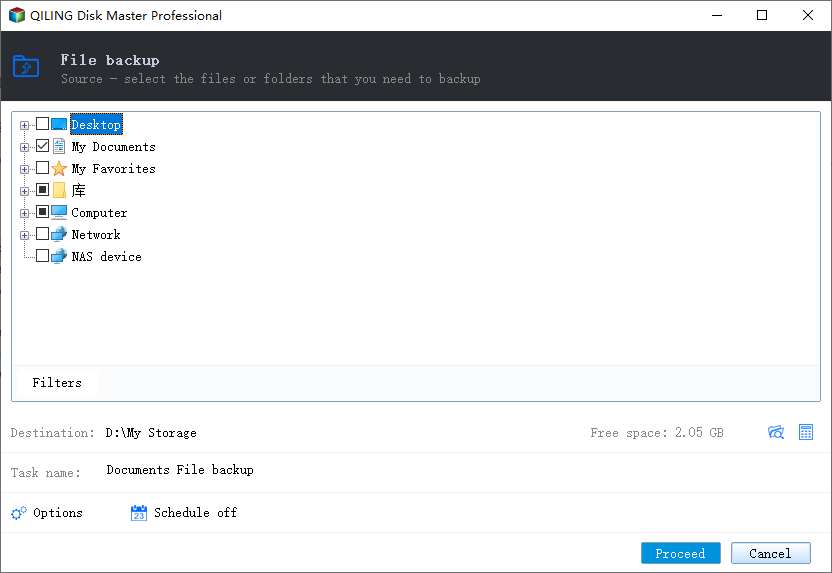
You need to click the icon relating to the Scheme that appears amongst others on the backup screen.
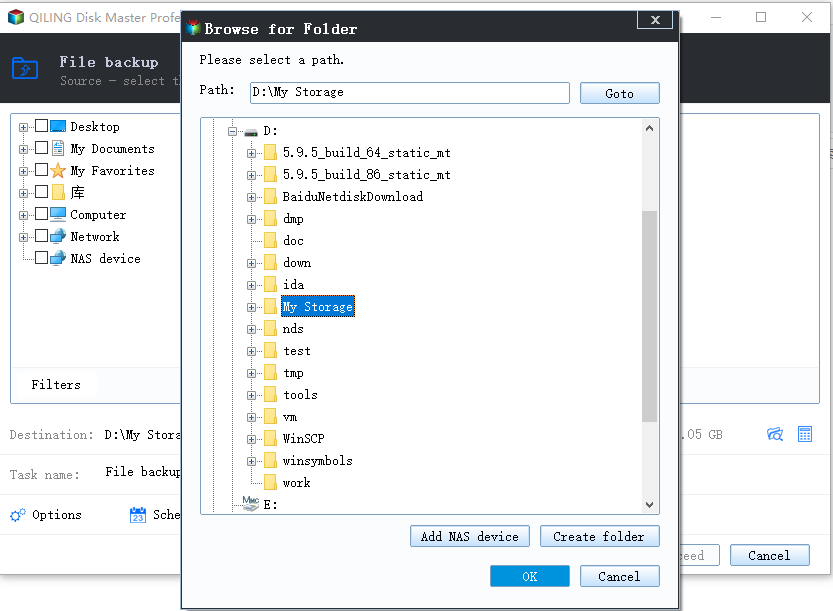
Detailed Introduction of the Backup Scheme
Qiling Centralized Disk Master supports five backup schemes: Differential Backup Scheme, Incremental Backup Scheme, Space Management Scheme, Full Backup Scheme, and Other Backup Scheme.
Differential Backup Scheme
1. Retain the latest versions of a backup image file, deleting older ones when the total number of versions exceeds a certain threshold.
2. The Differential Backup Scheme creates a group with a full backup and multiple differential backups, then deletes the differential backups one by one within the group, before finally deleting the full backup.
Example:
When you set the value to "3", Qiling Disk Master will keep the latest 3 versions of a backup image file, deleting the oldest ones when it exceeds this number. For example, if you have FULL1.adi, DIFF1.adi, DIFF2.fvd and create a new backup FULL2.fvd, the oldest DIFF1.adi will be automatically deleted.
If you select the option to create a full backup and always retain it before applying the backup scheme, it will first create a full backup and then apply the backup scheme, ensuring the full backup is always retained.
FULL(original)→FULL1→DIFF1→DIFF2→FULL2(deleteDIFF1)→DIFF3(deleteDIFF2)→DIFF4 (delete FULL1)→FULL2(delete DIFF3)
If you don't tick the option, the procedure is:
FULL(original)→DIFF1→DIFF2→FULL1(deleteDIFF1)→DIFF3(deleteDIFF2)→DIFF4(delete FULL)→FULL2(delete DIFF3)
The minimum reserved version is 2 and the maximum reserved version is 100.
Incremental Backup Scheme
1. Retain the latest xxx versions of backup image files, and automatically delete the previous xxx versions when the number of versions is exceeded.
2. The Incremental Backup Scheme works like a group queue, where the previous group must be removed when the next group meets the requirements to join. A group consists of a full backup and multiple incremental backups.
Example:
By setting the value to "3", you're keeping the 3 latest versions of the image file, which are grouped together. When a new group is created, the older group is automatically deleted. For example, if you have FULL.fvd, INC1.fvd, INC2.fvd as one group, and then create a new group with FULL1.fvd, INC3.fvd, INC4.fvd, the older group will be deleted.
If you select the option to "Create a full backup and always retain it before performing the scheme", it will first create a full backup, then apply the backup scheme, and the full backup will be retained.
The backup sequence starts with a FULL backup, followed by a FULL1 and then incremental backups INC1, INC2, and INC3, after which the FULL1, INC1, and INC2 backups are deleted. Next, a FULL2 backup is taken, followed by incremental backups INC4 and INC5, after which the FULL1, INC1, and INC2 backups are deleted.
If you don't tick the option, the procedure will be:
A FULL backup was taken, followed by incremental backups INC1 and INC2, then a FULL1 backup, and then incremental backups INC3 and INC4. The FULL, INC1, and INC2 backups were then deleted, followed by a FULL2 backup, and then incremental backups INC5 and INC6, after which the FULL1, INC3, and INC4 backups were deleted.
The minimum reserved version is 2, and the maximum reserved version is 100.
Space Management Scheme
1. This scheme considers the specified XXX backup versions as one group, treating them as a single unit for backup purposes, similar to a differential backup. It is intended for use with differential backups.
2. The Space Management Scheme will automatically create a new backup group and delete old backup image files when there's insufficient space to store new backups. This ensures that there's always enough space for the latest backups.
3. The scheme will delete differential backups one by one, starting with the oldest, within each group, followed by the deletion of the full backup of that group.
Example:
When creating backups, the program generates multiple versions, including FULL.fvd, DIFF1.fvd, DIFF2.fvd, FULL1.fvd, DIFF3.fvd, and DIFF4.fvd. If a new full backup, FULL3.fvd, is created but there's not enough space, the program will delete the oldest differential backup, DIFF1.fvd, followed by DIFF2.fvd, then the oldest full backup, FULL.fvd, and so on, until there's enough space for the new backup.
If you select the option to "Create a full backup and always retain it before performing the scheme", it will first create a full backup before applying the backup scheme circular queue, ensuring the full backup is always retained. This procedure involves creating a full backup first, then applying the backup scheme, and finally retaining the full backup.
The backup process starts with a FULL backup, then creates a DIFF1 backup, followed by a DIFF2 backup, and so on, until a FULL2 backup is created. If there's not enough space, Disk Master will delete the earliest DIFF backup, such as DIFF1, and continue with the next DIFF backup, repeating this process until a FULL2 backup is created, and then the process continues with DIFF3, DIFF4, and so on, until a FULL3 backup is created, and finally a FULL4 backup is created.
If you do not select the "Make a full backup before performing backup scheme" option, the procedure is to proceed with the backup scheme without creating a full backup first. This means that the backup scheme will start from the current state of your data, and any subsequent backups will be incremental, building on the previous backup.
Disk Master will delete the oldest differential backups first, followed by full backups, repeating this pattern until enough space is freed for the new backup.
Full Backup Scheme
1. Always keep the latest xxx versions of full backup image files. If the number of versions exceeds, automatically delete the oldest full backup image file.
2. The Full Backup Scheme is a system where when the queue is full, the oldest members are removed to make room for new ones.
Example:
When a value of 3 is set, it means the latest 3 versions of full backup image files are retained. If more than 3 versions are created, the oldest one is automatically deleted, for example, if we have FULL.fvd, FULL1.fvd, FULL2.fvd, and a new FULL3.fvd is created, the oldest FULL.fvd will be deleted.
If you tick "Create a full backup and always retain it before performing the scheme" option, it will first create a FULL backup before applying the backup scheme circular queue and the full backup will always be retained, the procedure is:
FULL→FULL1→FULL2→FULL3→FULL4 (delete FULL1)→FULL5 (delete FULL2)→FULL6 (delete FULL3)→FULL7 (delete FULL4)
If you don't tick the option, the procedure will be:
FULL→FULL1→FULL2→FULL3(delete FULL)→FULL4 (delete FULL1)→FULL5(delete FULL2)→FULL6 (delete FULL3)
The minimum reserved version is 1, the maximum reserved version is 10.
Other Backup Scheme
There are two ways to delete the previous versions of the backup image file. The first method is to use the "Delete Previous Versions" option in the backup software, which will automatically remove the oldest version of the backup image file when a new one is created. The second method is to manually delete the previous versions of the backup image file from the backup destination.
1. The system will automatically create a new full backup after exceeding a certain time threshold. Once this threshold is reached, a new full backup will be created and all previous backup files will be deleted.
The system will automatically create a new full backup when it exceeds a certain time limit, such as 3 days, and will delete the previous versions of the backup files.
If you select the "Do not delete the image file of the first backup during disk space management" option, the first backup image file will be preserved, and disk space management will not delete it. This ensures that the first backup image file remains intact, even if subsequent backups are deleted to free up disk space.
The backup process involves creating a full backup, followed by incremental backups, and then repeating the cycle. The full backup is followed by incremental backups (INC1, INC2, INC3, INC4), which are then deleted. The cycle repeats with a new full backup (FULL2) and new incremental backups (INC5, INC6), and so on, until the next full backup (FULL3) is created, at which point the previous full backup (FULL2) and the previous incremental backups (INC5, INC6) are deleted. This process continues indefinitely.
2. To automatically delete the previous XXX versions of backup image files after the next full backup finishes, you can set up a scheduled task to run a script or a program that deletes the unwanted files. This can be achieved by using a tool like `cron` on Linux/macOS or the Task Scheduler on Windows. You can specify the number of versions to keep and the script will delete the rest.
The program will create a full backup after 3 backup versions have been created, and then delete the previous 3 oldest versions. For instance, if there are FULL1.fvd, INC1.fvd, and INC2.fvd, it will create a new full backup, say FULL2.fvd, and then delete the oldest versions, which are FULL1.fvd, INC1.fvd, and INC2.fvd. This process repeats with the next full backup.
If you select the option "Do not delete the image file of the first backup during disk space management", the first backup image file will be preserved during disk space management, ensuring its availability for future reference or analysis. This means that even when the disk space is low, the first backup image file will not be deleted, allowing you to access it later if needed.
The backup process starts with a full backup, followed by incremental backups, and then another full backup, with the older full and incremental backups being deleted after the newer full backup is created.
Notes:
- If you've already done multiple backups (full, incremental, differential) before enabling a backup scheme for a task, those previous backup files won't be deleted by the scheme.
- If you've set a different backup method through Schedule Settings than the one specified in the Backup Scheme, the backup will be performed as per the Schedule Settings, overriding the Backup Scheme settings. For example, if you've set an incremental schedule backup and chosen the differential backup scheme, the task will run as a differential backup.
- If you've already backed up some files using a previous backup scheme, and then you switch to a new backup scheme, Qiling Disk Master will start the backup queue again with the new scheme, but it won't delete the files already backed up with the old scheme.
- If there's not enough space for backup versions within one group, Qiling Disk Master won't delete old backups to free up space, so please ensure there's enough space for all backup versions in one group.
Related Articles
- Easily Securely Erase SSD Windows 10 without Affecting Performance
In this guide, you will learn how to securely erase an SSD in Windows without damaging its performance and lifespan. - Best Tool for SSD Speed Test Windows 10
You can easily test your SSD speed on Windows 10 by trying out two simple methods. To find out your SSD's read and write speed, you can follow the steps outlined in this article and complete the process on your own. - Unable to Extend C Drive in Windows 10/8/7 [Solved]
Fix unable to extend C drive in Windows 11/10/8/7 when Disk Management cannot use unallocated space, with practical partition resizing solutions. - Upgrade Hard Drive in Windows 10 - No Reinstallation
This tutorial highlights the importance of upgrading to a solid-state drive (SSD) in Windows 10 and provides a step-by-step guide on how to upgrade a hard drive to an SSD using the best cloning software.
Products
Articles & Tutorials
- Data Recovery
- Data Backup
- File Recovery
- File Backup
- File synchronize
- System Backup and Restore
- Disk and Partition Clone
- Technical articles
- Disk Master Help
- Windows Deleted File and Disk Recovery Tutorials
- Windows File and Data Recovery Tutorials
- More Windows Tutorials for Install, Security, Files, and PC Tips
- Windows Boot, Repair, and Recovery Environment Tutorials
- Windows Backup Tutorials
- Windows Restore Tutorials
- Windows Clone and Migration Tutorials
- Windows Server Backup, Recovery, and Management Tutorials
- Windows Disk, Partition, and Storage Management Tutorials