How to Merge Partitions on Disk?
If you have a partitioned hard disk and are running out of space on one partition, you can either merge partitions or extend the partition to add free space to the low disk space partition. For example, if Windows 7 is installed on C: and it's running out of space, you can merge free space from D: or extend the C: partition to add free space.
Merge two partitions into one big partition
To merge partitions on a disk without losing data, you can use a disk management tool like Disk Management in Windows. Here's a step-by-step guide:
To merge Drive C and Drive D without losing data, you can use the Disk Management tool in Windows 7. Here's how: Open Disk Management, select Drive D, and initialize it. Then, select Drive C and increase its size to include the space from Drive D. This will merge the two drives without formatting Drive C or reinstalling Windows 7, ensuring your data remains intact.
Using Qiling Disk Master to merge partitions
Windows built-To merge partitions using Qiling Disk Master Standard, you can follow these steps:
Note:
- You could merge any unallocated space into any existing partition.
- Partition Assistant can only merge up to two partitions at a time.
- To merge partitions, the two partitions must be adjacent.
- You can merge data partition into system partition, but not the other way around.
- In Windows 7, the "system reserved" partition could not be merged with the main partition, whereas in Windows 8 and later versions, this is possible.
Step 1.To merge partitions using Qiling Disk Master, download and install it, then launch the program. You'll see the basic environment of your disks. To merge partitions, select the partition you want to merge and right-click it, then choose "Disk management" and click "Move/resize Partitions" to proceed.
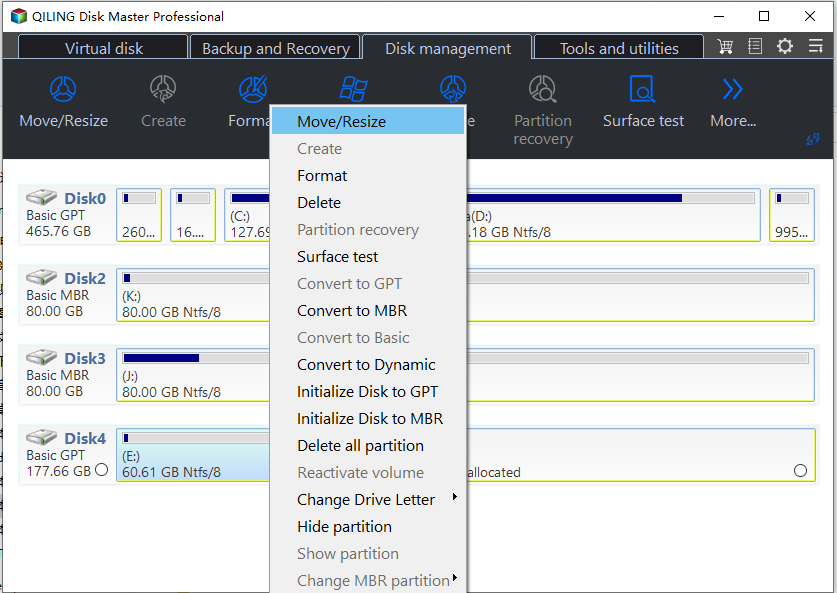
Step 2. After clicking "Merge" in the Disk Management tool, a window will appear where you can select the option to merge the drive with the other drive. This will allow you to combine the two drives into a single, larger drive, effectively increasing the storage capacity of your system.
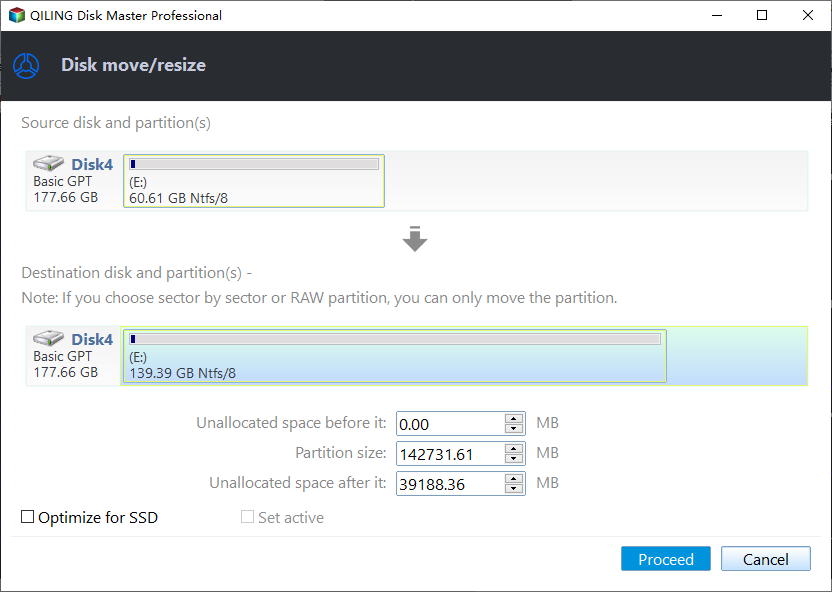
Step 3. The two partitions have been merged on the disk, and clicking the Proceed button will finalize the progress.
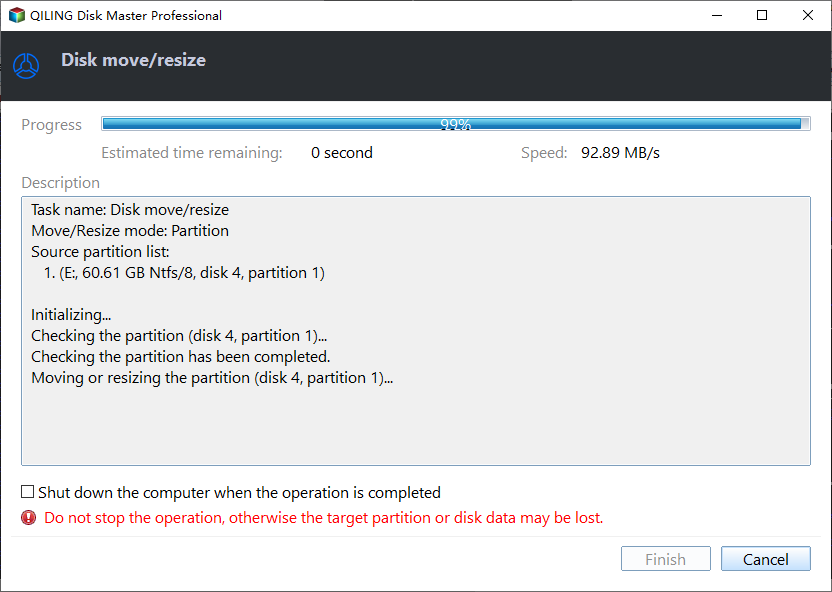
Combining two partitions on a hard disk can be achieved in just two steps using specialized software. This process ensures smooth performance and high reliability, eliminating the risk of data loss and the need to reinstall the Windows operating system.
Qiling Disk Master Professional (PA Pro) is a Windows partition manager that allows users to choose which partition to resize, and also performs functions such as allocating free space, cloning disks, copying partitions, and managing dynamic disks.
Related Articles
- Windows 7 Enterprise End of Life: How to Upgrade to Windows 10
You can get a clear overview of Windows 7 enterprise end of life and how to prepare for the extended support end. Please scroll down to learn more. - Windows 7 Maximum Disk Size Problem | Fix It Right Now!
You will learn more about Windows 7 maximum disk size and fix it step by step. Sroll down to get the details. - Backup Windows 8 to External Hard Drive and Protect Security
You can learn to backup Windows 8 to external hard drive in two practical ways. And you don't need to worry about downtime and avoid data loss caused by system crash or other issues - How to Easily Clone SSD to HDD in Windows 8/8.1? (4 Steps)
You can learn to easily clone SSD to HDD or clone HDD to SSD in Windows 8/8.1 with the help of professional disk cloning software - Qiling Disk Master Professional. - Free FBackup Alternative You Need to Backup Windows 10/8/7
As the best free alternative to FBackup, Qiling Disk Master is easier to use and provides more features than FBackup. - Best Free File History Alternative for Windows 8/8.1/10
This guide explains Best Free File History Alternative for Windows 8/8.1/10 with clear steps, key checks, and practical tips.
Products
Articles & Tutorials
- Data Recovery
- Data Backup
- File Recovery
- File Backup
- File synchronize
- System Backup and Restore
- Disk and Partition Clone
- Technical articles
- Disk Master Help
- Windows Deleted File and Disk Recovery Tutorials
- Windows File and Data Recovery Tutorials
- More Windows Tutorials for Install, Security, Files, and PC Tips
- Windows Boot, Repair, and Recovery Environment Tutorials
- Windows Backup Tutorials
- Windows Restore Tutorials
- Windows Clone and Migration Tutorials
- Windows Server Backup, Recovery, and Management Tutorials
- Windows Disk, Partition, and Storage Management Tutorials